Introduction
This guide explains how individuals can safely resume cooking after wrist surgery. Readers will learn a realistic recovery timeline, adaptive techniques for the kitchen, and a selection of easy meals that minimise strain. The article also recommends three ergonomic tools that can reduce effort and improve safety during the healing process. By following the steps outlined, one can regain confidence in the kitchen while protecting the surgical site.
Background and Context
Wrist surgery typically involves immobilisation, followed by gradual mobilisation to restore range of motion and strength. Healing proceeds through three phases: inflammation (first week), proliferative repair (weeks 2‑6), and remodelling (weeks 6‑12). During each phase, the surgeon may restrict weight‑bearing activities, including gripping and twisting motions. Understanding these phases is essential for planning safe kitchen activities and for selecting adaptive tools that align with the current level of wrist capability.
Key concepts include grip strength, wrist extension, and pronation‑supination. Grip strength is measured in pounds and often drops to 30‑40% of baseline after surgery. Wrist extension is the ability to lift the hand upward; limited extension can make opening jars difficult. Pronating and supinating the forearm are required for turning bottle caps and using standard knives. Adaptive tools compensate for these deficits by providing leverage, non‑slip surfaces, or alternative hand positions.
Recovery Timeline and Adaptive Kitchen Strategies
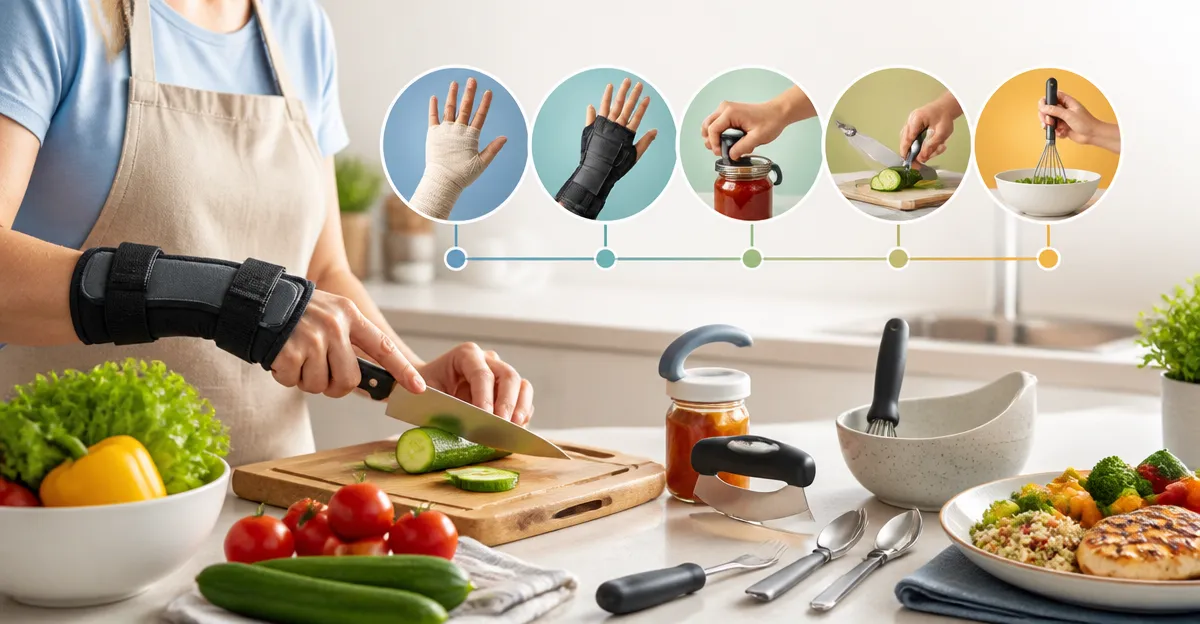
Week 1‑2: Immobilisation and Light Tasks – The wrist is usually in a splint or cast. At this stage, avoid any activity that requires a firm grip. Use the opposite hand for stirring and employ pre‑cut ingredients. A simple salad with pre‑washed greens and pre‑sliced vegetables can be assembled without using the injured wrist.
Week 3‑4: Early Mobilisation – Under therapist guidance, begin gentle range‑of‑motion exercises. Light kitchen tasks such as opening a pre‑loosened jar with a rubber grip become feasible. The SUNRAYNEST Jar Opener Set provides a non‑slip grip and lever‑based opening mechanism, reducing the need for wrist torque. Its ergonomic handles distribute force across the palm, protecting the surgical site while allowing the user to open jars, bottles, and cans safely.
Week 5‑6: Strength Building – As pain diminishes, incorporate light resistance exercises and begin using standard kitchen tools with caution. The BackEZ Ergonomic Shovel Handle can be repurposed as an auxiliary grip for long‑handled tools such as garden trowels or even oversized kitchen spoons, providing a higher hand position that reduces wrist flexion.
Week 7‑12: Functional Independence – Full range of motion and strength return. At this point, one may transition to regular knives and cookware. The Coowolf Mezzaluna Knife offers an enlarged ergonomic handle that minimises wrist strain while chopping herbs or vegetables. Its curved stainless‑steel blade requires a rocking motion rather than a chopping motion, which is gentler on the recovering wrist.
Product Recommendations and How They Add Value
Each product listed below addresses a specific challenge faced by wrist‑surgery patients.
- SUNRAYNEST Jar Opener Set – Rated 4.7 out of 5 stars from 68 reviews, this three‑piece set includes a 5‑in‑1 multi‑opener, a 4‑in‑1 jar opener, and a silicone gripper mat. The soft, non‑slip handles maximise leverage, allowing users to open tight lids without excessive wrist extension. Its compact design nests for drawer storage, keeping the kitchen organised.
- BackEZ Ergonomic Shovel Handle – Constructed from UV‑stabilised resin, this attachment weighs only 7.3 oz and fits shaft diameters from 7/8" to 1½". The EVR‑GRIP rubber strip secures instantly, and the offset design reduces back bend by approximately 30 %. Although marketed for outdoor tools, the handle can be attached to long kitchen implements to raise the grip point, thereby decreasing wrist flexion.
- Coowolf Mezzaluna Knife – Featuring a 6.5‑inch stainless‑steel curved blade and a walnut wood handle, this rocker knife enables a rocking motion that distributes cutting forces across the forearm rather than the wrist. The enlarged handle reduces wrist strain during prolonged chopping, and the included walnut stand provides safe upright storage.
Comparison and Selection Guide
| Feature | SUNRAYNEST Jar Opener Set | BackEZ Ergonomic Shovel Handle | Coowolf Mezzaluna Knife |
|---|---|---|---|
| Primary Function | Jar, bottle, and can opening | Grip extension for long‑handed tools | Rocking chopping of herbs, vegetables, meat |
| Material | Durable polymer and silicone | UV‑stabilised resin with rubber strip | Stainless steel blade, walnut wood handle |
| Weight | Lightweight, portable | 7.3 oz | Approximately 1 lb (blade only) |
| Rating | 4.7/5 (68 reviews) | Not listed | Not listed |
| Best For | Patients needing assistance with tight lids | Individuals who prefer a higher grip on long tools | Those who chop frequently and need wrist‑friendly motion |
Best Practices & Tips for Cooking After Wrist Surgery
- Plan meals that require minimal chopping. Pre‑cut vegetables or use a food processor during the early weeks.
- Utilise adaptive tools such as the SUNRAYNEST Jar Opener Set to avoid using excessive wrist torque.
- Maintain a neutral wrist position by keeping the forearm supported on the countertop while stirring or mixing.
- Adopt a rocking cutting technique with the Coowolf Mezzaluna Knife; this reduces repetitive wrist flexion.
- When using long‑handled tools, attach the BackEZ Ergonomic Shovel Handle near the centre of the shaft to raise the grip point and keep the wrist straight.
- Perform prescribed hand‑therapy exercises before and after cooking sessions to improve circulation and prevent stiffness.
- Keep the kitchen well‑organised; store adaptive tools within easy reach to minimise unnecessary movements.
Frequently Asked Questions
Can I use a regular jar opener during the first two weeks?
No. Conventional jar openers require a firm grip and wrist torque that may jeopardise the surgical repair. An ergonomic tool such as the SUNRAYNEST Jar Opener Set provides the necessary leverage without stressing the wrist.
Is the BackEZ handle safe for indoor kitchen use?
Yes. The handle is made from lightweight resin and features a non‑slip rubber strip that can be attached to any long‑handled kitchen utensil, such as a large spoon or a pasta server. Its offset design reduces back bend and wrist flexion, making it safe for indoor use.
How does the rocking motion of a mezzaluna protect the wrist?
The rocking motion distributes cutting forces across the forearm and uses a pendulum‑like action rather than a vertical chopping motion. This reduces repetitive wrist extension and flexion, which are common sources of discomfort after surgery.
Should I wait until the remodeling phase to start using a knife?
Light chopping with an ergonomic knife can begin during the proliferative phase (weeks 2‑6) if the surgeon approves and the patient experiences minimal pain. The Coowolf Mezzaluna Knife, with its enlarged handle, is a suitable option because it limits wrist strain.
What if I experience swelling while using adaptive tools?
Stop the activity immediately and apply a cold compress to the wrist. Consult the healthcare provider to ensure that swelling is not a sign of overuse. Adjust the tool placement or choose a tool with a larger grip surface to reduce pressure.
Conclusion
Recovering from wrist surgery does not mean abandoning the joy of cooking. By following a structured timeline, employing ergonomic tools, and practising safe techniques, one can regain functional independence in the kitchen. The SUNRAYNEST Jar Opener Set, BackEZ Ergonomic Shovel Handle, and Coowolf Mezzaluna Knife each address a specific challenge, offering practical support throughout the healing journey. Consistent hand‑therapy, mindful positioning, and thoughtful meal planning will further accelerate recovery and enhance long‑term wrist health.
Products Featured in This Guide
SUNRAYNEST Jar Opener Set
Rating: 4.7/5.0 (68 reviews)
Why featured: Provides a non‑slip, lever‑based solution for opening jars, bottles, and cans, reducing wrist torque during the early recovery phases.
BackEZ Ergonomic Shovel Handle
Why featured: Offers an adjustable, high‑position grip for long‑handled tools, allowing the wrist to remain in a neutral position while performing kitchen tasks.
Coowolf Mezzaluna Knife
Why featured: Enables a rocking chopping motion with an enlarged ergonomic handle, reducing repetitive wrist strain during food preparation.