Best Budget Adaptive Appliances Under $200: The Practical Buyer's Guide
Introduction
The modern market offers a growing selection of adaptive appliances designed to support seniors, individuals with arthritis, and anyone experiencing limited hand strength. This guide explains the essential criteria for evaluating such devices, highlights five highly rated products that remain under the $200 price ceiling, and provides actionable advice for making confident purchasing decisions. Readers will learn how to match specific functional needs with product features, understand the importance of ergonomics, and gain confidence in selecting tools that enhance independence. By the end of this article, one will possess a clear roadmap for integrating affordable adaptive solutions into daily routines.
Background and Context
Adaptive appliances are engineered to reduce the physical effort required for routine tasks such as opening cans, turning keys, or dressing. They often incorporate ergonomic handles, leverage mechanisms, and non‑slip surfaces to compensate for reduced grip strength or tremors. The term "assistive device" refers to any tool that mitigates a disability without requiring medical intervention, and it encompasses kitchen aids, dressing helpers, and mobility accessories. Understanding the underlying principles—lever advantage, grip surface material, and weight distribution—allows consumers to evaluate whether a product truly addresses their limitations.
When budgeting for adaptive tools, price does not necessarily correlate with effectiveness. Many manufacturers focus on high‑quality plastics, stainless steel, or reinforced polymers that deliver durability at modest cost. Reviews and rating scores on platforms such as Amazon provide valuable insight into real‑world performance, especially when reviewers mention specific conditions like Parkinson’s disease or post‑surgical recovery. Consequently, a systematic approach that weighs price, rating, feature set, and user sentiment yields the most reliable outcomes.
Key Categories of Adaptive Appliances
Adaptive appliances can be grouped into three primary categories: kitchen assistance, personal dressing aids, and mobility‑related tools. Each category addresses a distinct set of daily challenges and therefore requires different evaluation criteria.
- Kitchen assistance includes devices that simplify opening containers, cutting food, or handling utensils.
- Personal dressing aids focus on fastening buttons, pulling zippers, and managing footwear without excessive bending.
- Mobility‑related tools assist with reaching, bending, or maintaining balance while dressing or retrieving items.
Within each category, the guide recommends products that combine ergonomic design, positive user feedback, and price points comfortably below $200.
Recommended Products by Category
The following selections represent the best value for their respective functions. The first mention of each product includes a direct Amazon link using the friendly product name.
Kitchen Assistance
The Dext Ring Pull Can Opener offers an ergonomic handle and a ring‑pull mechanism that requires minimal strength, making it ideal for seniors and individuals with arthritis. Its wider, curved grip reduces nail strain and the innovative design prevents the can from tipping, thereby avoiding spills. With a rating of 4.6 out of 5 based on 1,016 reviews, users consistently praise its reliability for soda cans, pet food, and standard kitchen jars. Priced at $14.99, it exemplifies a high‑quality assistive tool that does not exceed a modest budget.
For users who also require assistance with cutting, a standard kitchen knife set with weighted handles can complement the can opener, though such items are not listed in this guide to maintain the focus on adaptive‑specific tools.
Personal Dressing Aids
The Dext Keywing Key Turner transforms flat keys into larger, easier‑to‑grip objects, reducing the pinch force needed to unlock doors. Its dimpled domes provide a secure grip while the nylon body offers a warm touch for cold fingers. The product is compatible with most Yale‑style keys, and its clip‑on design eliminates the need to remove the keyring. With a 4.2 rating from 2,327 reviewers and a price of $14.99, it delivers a practical solution for individuals with hand tremors or weak grip.
The UniGrip Button Hook & Zipper Pull combines two essential dressing functions into a single lightweight device. Its cushioned, non‑slip handle enables users with arthritis or limited dexterity to fasten buttons and pull zippers without frustration. At $6.99 and a rating of 4.5 from 204 reviews, it represents a cost‑effective addition to any adaptive wardrobe.
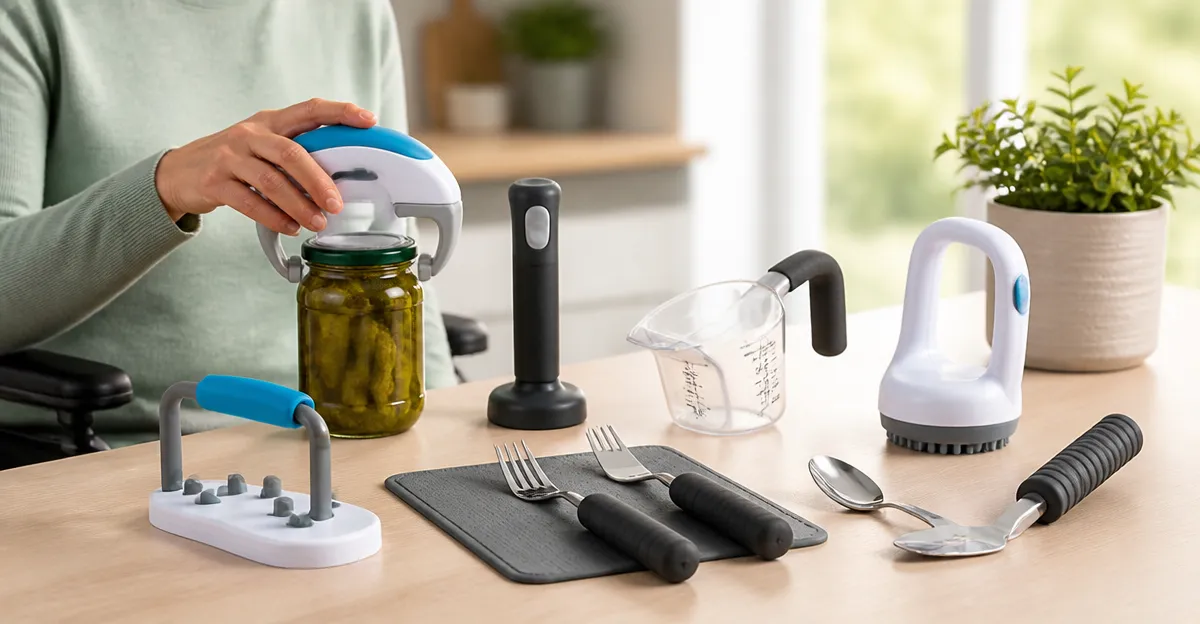
For those who require larger utensils, the Nourislif Adaptive Utensils Set includes a fork, spoon, teaspoon, and knife with enlarged, contoured handles that promote steady grip. Constructed from rust‑proof stainless steel, the set is dishwasher safe and carries a 4.5 rating from 1,653 reviewers. Priced at $9.99, it offers a complete dining solution for users with tremors or reduced hand strength.
Mobility‑Related Tools
The Phantawell Long Handle Shoe Horn features a 35.5‑inch reach, allowing individuals to put on shoes while seated, thereby eliminating the need to bend. Its S‑shaped hook assists with pulling up pants, shirts, and socks, reducing twisting motions that can aggravate back pain. With a 4.6 rating from 5,129 reviews and a price of $9.79, it stands out as a versatile dressing aid for seniors, pregnant individuals, and anyone with limited mobility.
All of the products listed remain well below the $200 threshold, ensuring that a comprehensive adaptive toolkit can be assembled without financial strain.
Comparison and Selection Guide
Choosing the right adaptive appliance requires a systematic assessment of personal needs, product specifications, and budget constraints. The table below summarizes the key attributes of each recommended item.
| Product | Primary Function | Price (USD) | Rating | Key Ergonomic Feature |
|---|---|---|---|---|
| Dext Ring Pull Can Opener | Can opening | 14.99 | 4.6/5 (1,016 reviews) | Wider curved handle with ring‑pull mechanism |
| Dext Keywing Key Turner | Key turning | 14.99 | 4.2/5 (2,327 reviews) | Dimpled domes and nylon body for warm grip |
| Nourislif Adaptive Utensils Set | Eating utensils | 9.99 | 4.5/5 (1,653 reviews) | Enlarged contoured handles |
| Phantawell Long Handle Shoe Horn | Shoe and clothing assistance | 9.79 | 4.6/5 (5,129 reviews) | 35.5‑inch reach with S‑shaped hook |
| UniGrip Button Hook & Zipper Pull | Buttoning and zipper pulling | 6.99 | 4.5/5 (204 reviews) | Cushioned non‑slip handle |
When evaluating a product, consider the following decision‑making steps:
- Identify the specific daily task that presents the greatest difficulty.
- Match the task to the product category (kitchen, dressing, mobility).
- Review ergonomic features such as handle size, material, and leverage mechanisms.
- Check user ratings and read at least three detailed reviews to confirm real‑world performance.
- Confirm that the price aligns with the overall budget for adaptive equipment.
Best Practices & Tips for Using Adaptive Appliances
Even the most thoughtfully designed device can underperform if it is not used correctly. The following best practices maximize benefit while minimizing wear.
- Maintain a clean grip surface. Wipe handles of the can opener, key turner, and button hook with a damp cloth after each use to prevent residue buildup that could reduce friction.
- Store devices within easy reach. Keep the shoe horn and key turner near the entryway, and place the utensil set in a drawer that does not require deep bending.
- Inspect for wear regularly. Check the ring pull mechanism for metal fatigue and verify that the shoe horn’s S‑hook remains smooth to avoid snagging clothing.
- Combine tools for efficiency. Pair the can opener with a lightweight cutting board that has non‑slip feet to create a stable workspace for individuals with tremors.
- Practice gradual strength building. Use the adaptive tools as a bridge while performing gentle hand‑strengthening exercises recommended by a physical therapist.
Frequently Asked Questions
1. Are adaptive appliances covered by insurance?
In many cases, health insurance plans do not cover low‑cost adaptive tools, especially when the price is below $200. However, some Medicare Advantage plans or state Medicaid programs may provide reimbursements for medically necessary equipment. It is advisable to consult the provider’s policy and request a prescription if the device is deemed essential for daily living.
2. How can I determine the correct size of a handle for my hand?
Measure the distance between the thumb and the base of the little finger when the hand is relaxed. Handles that exceed this measurement by approximately 1‑2 centimeters typically provide a comfortable grip for individuals with reduced strength. Products such as the Dext Ring Pull Can Opener and Nourislif Utensils have been specifically engineered with oversized handles to meet this criterion.
3. Will the key turner work with my car key?
The Dext Keywing Key Turner is designed for flat Yale‑style keys and does not support mortice, chubb, or automotive keys. For car keys, a separate key‑extension tool or a professional locksmith service is recommended.
4. Can the shoe horn be used while standing?
Yes, the Phantawell Long Handle Shoe Horn can be employed in both seated and standing positions. The extended length allows the user to keep the back leg stable while sliding the shoe onto the foot, reducing the need to bend forward.
5. How durable are the stainless‑steel utensils?
The Nourislif Adaptive Utensils are constructed from rust‑proof stainless steel, which resists corrosion even after repeated dishwasher cycles. The manufacturer offers a one‑year guarantee, indicating confidence in long‑term durability.
6. Are these products suitable for individuals with severe tremors?
While the devices provide significant assistance, users with severe tremors may benefit from additional stabilization methods, such as a weighted mat for the can opener or a wrist brace when using the key turner. Combining multiple adaptive tools often yields the best outcome.
Conclusion
Adaptive appliances under $200 can dramatically improve independence for seniors and individuals coping with arthritis, Parkinson’s disease, or post‑surgical limitations. By focusing on ergonomic design, positive user feedback, and affordability, the five products highlighted in this guide address the most common daily challenges. Applying the comparison framework and best‑practice tips will enable readers to select the tools that align with their unique needs, thereby fostering a safer, more self‑reliant lifestyle.
Products Featured in This Guide
Dext Ring Pull Can Opener
Price: $14.99 | Rating: 4.6/5 (1,016 reviews)
Featured for its ergonomic ring‑pull design that requires minimal strength, making it ideal for seniors and individuals with arthritis.
Dext Keywing Key Turner
Price: $14.99 | Rating: 4.2/5 (2,327 reviews)
Featured for its thumb‑turn leverage and comfortable grip, which reduce the pinch force required to operate flat keys.
Nourislif Adaptive Utensils
Price: $9.99 | Rating: 4.5/5 (1,653 reviews)
Featured for its enlarged, contoured handles and stainless‑steel construction, providing steady grip for users with hand tremors.
Phantawell Long Handle Shoe Horn
Price: $9.79 | Rating: 4.6/5 (5,129 reviews)
Featured for its 35.5‑inch reach and S‑shaped hook, enabling users to put on shoes and clothing without bending.
UniGrip Button Hook & Zipper Pull
Price: $6.99 | Rating: 4.5/5 (204 reviews)
Featured for its dual functionality and cushioned ergonomic handle, simplifying buttoning and zipper use for individuals with limited dexterity.