Guide to Color Contrast Design for Mixed‑Vision Kitchens: Practical Tips for Accessible, Low‑Vision‑Friendly Spaces
Introduction
One will find that color contrast is a fundamental principle for creating kitchens that are safe and usable for individuals with low vision. This guide explains the theory behind contrast, illustrates how to apply it to cabinets, countertops, and appliances, and recommends accessories that enhance accessibility without compromising style. Readers will learn how to select appropriate hues, integrate slip‑resistant surfaces, and organize storage with products that support ease of movement. By the end of the article, one will possess a clear plan for designing a kitchen that balances aesthetic appeal with functional clarity.
Background and Context
Low‑vision users rely heavily on visual cues such as brightness differences, edge definition, and texture to navigate a space safely. The human eye detects contrast more readily than subtle color variations, especially when visual acuity is reduced. Research in universal design indicates that a contrast ratio of at least 3:1 between foreground and background elements reduces the risk of accidents. Understanding these principles enables designers and homeowners to make informed decisions that benefit all occupants, regardless of visual ability.
Key Concepts in Color Contrast
One should begin by distinguishing between hue contrast and luminance contrast. Hue contrast involves selecting colors that are opposite on the color wheel, such as blue and orange, while luminance contrast focuses on differences in lightness, such as dark cabinets against a light countertop. Luminance contrast is often more reliable for low‑vision users because it does not depend on color perception. In practice, combining both types of contrast yields the most robust visual guidance.
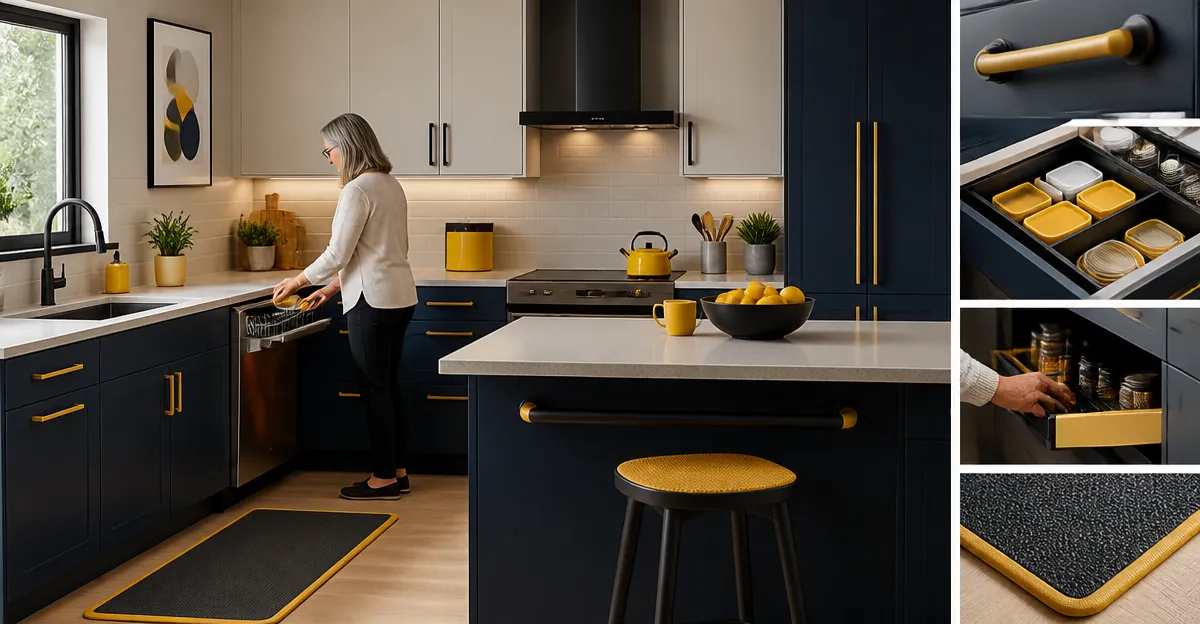
When applying contrast, it is advisable to use a limited palette to avoid visual clutter. A typical scheme might include a deep navy for upper cabinets, a crisp white for countertops, and a bright accent color for drawer pulls. The accent color should be used sparingly to draw attention to high‑use areas such as the stove controls or the sink faucet. Consistency across the kitchen reinforces familiar patterns, allowing the user to anticipate the location of essential items.
Slip‑Resistant Surfaces and Accessibility
Contrast alone does not guarantee safety if floor and countertop surfaces are slippery. Adding slip‑resistant accessories can dramatically improve stability for individuals who may be uncertain of their footing. The Animal‑Gifts Appliance Sliders provide a practical solution for moving heavy appliances without dragging them across the floor. These self‑adhesive PTFE sliders raise appliances by 0.79 inches, protecting both the appliance and the flooring from water damage and scratches.
Each slider set includes twenty‑four pieces, allowing one to equip multiple devices such as a coffee maker, toaster, or blender. The smooth PTFE surface reduces friction, enabling easy repositioning while maintaining a firm grip on wood, metal, glass, or plastic surfaces. Users can install the sliders in three simple steps: clean the appliance base, remove the protective backing, and press the slider into place. This straightforward process ensures that even individuals with limited dexterity can benefit from the technology.
Enhancing Grip on Containers and Jars
Opening jars and bottles is a frequent source of frustration for low‑vision users, especially when lids are tightly sealed. The LUTER Jar Opener Pads address this challenge by providing textured silicone surfaces that increase friction between the hand and the lid. The set includes four pads in two shapes—square and round—each measuring approximately five inches across, which accommodates a wide range of container sizes.
These pads are crafted from tear‑resistant rubber that remains soft to the touch, ensuring comfort during repeated use. To operate, one places a pad on the lid and twists in the indicated direction; the textured surface prevents slippage, allowing even users with weaker hand strength to open stubborn containers. Beyond their primary function, the pads can double as heat‑insulating coasters, protecting countertops from hot pots and reducing the risk of burns.
Organizing with Rotating Storage Solutions
Efficient organization reduces the need for reaching into deep cabinets, a task that can be hazardous for low‑vision individuals. The Oizeir Lazy Susan offers a compact, non‑skid turntable that maximizes storage accessibility in cabinets, pantries, and countertops. Measuring ten inches in diameter, the turntable can support heavy items without wobbling, thanks to its smooth, sturdy spinning mechanism.
Its textured top surface prevents items from sliding off during rotation, while a low functional edge keeps dishes and spices within easy reach. Constructed from high‑quality plastic, the Lazy Susan is easy to clean and rated 4.8 out of 5 stars by seven hundred forty‑five reviewers, indicating strong customer satisfaction. Priced at $17.99, it provides an affordable upgrade that enhances both organization and safety.
Comparison and Selection Guide
| Feature | Animal‑Gifts Appliance Sliders | LUTER Jar Opener Pads | Oizeir Lazy Susan |
|---|---|---|---|
| Primary Function | Facilitate movement of appliances | Increase grip on lids and serve as coasters | Rotate stored items for easy access |
| Quantity Included | 24 pieces (0.79" diameter) | 4 pads (2 shapes) | Set of 4 turntables |
| Material | PTFE (Teflon) self‑adhesive | Durable rubber silicone | Sturdy plastic with textured top |
| Installation | Peel‑and‑stick, three‑step process | Place on lid, twist | Place in cabinet, rotate as needed |
| Price (USD) | Not listed | Not listed | $17.99 |
| Rating | Not listed | Not listed | 4.8/5 (745 reviews) |
| Best Use Case | Appliance repositioning, floor protection | Jar opening, heat protection | Cabinet organization, pantry access |
Best Practices & Tips
- Choose a light‑on‑dark or dark‑on‑light scheme for countertops and backsplashes to create a clear visual boundary.
- Apply high‑contrast tape or paint to the edges of drawers and cabinets to highlight handles.
- Install the Animal‑Gifts Appliance Sliders under all movable appliances to prevent water damage and facilitate cleaning.
- Keep jar opener pads within easy reach on the countertop; their dual function as coasters reduces the number of items needed on the surface.
- Place the Oizeir Lazy Susan in corner cabinets to transform otherwise inaccessible spaces into organized zones.
- Use non‑reflective finishes on high‑contrast surfaces to avoid glare that can confuse low‑vision users.
- Maintain consistent lighting levels; task lighting should be positioned to illuminate work areas without creating harsh shadows.
Frequently Asked Questions
Q1: How much contrast is sufficient for low‑vision users?
A1: A contrast ratio of at least three to one between foreground and background is recommended, but higher ratios provide greater safety.
Q2: Can the appliance sliders be removed without damaging the floor?
A2: The PTFE sliders are designed to adhere securely yet can be removed by gently heating the adhesive with a hair dryer and peeling slowly, leaving minimal residue.
Q3: Are the jar opener pads safe for use with hot lids?
A3: Yes, the rubber material is heat‑resistant and can be used as a protective coaster for hot containers, reducing the risk of burns.
Q4: How much weight can the Oizeir Lazy Susan support?
A4: The turntable is engineered to hold typical kitchen items such as spice jars, canned goods, and small appliances without wobbling; user reviews indicate reliable performance up to approximately ten pounds per unit.
Q5: Is it necessary to replace all appliances with sliders, or only the heavy ones?
A5: One should prioritize heavy or frequently moved appliances, such as coffee makers and blenders, to maximize floor protection and ease of cleaning.
Q6: Do the jar opener pads require any special cleaning?
A6: The pads can be washed with mild soap and water; they dry quickly and retain their textured surface after repeated use.
Q7: Can the Lazy Susan be used outdoors?
A7: The product is intended for indoor use; exposure to extreme temperatures or moisture may degrade the plastic over time.
Conclusion
One can create a kitchen that is both visually appealing and accessible by thoughtfully applying color contrast, integrating slip‑resistant accessories, and organizing storage with rotating solutions. The recommended products—Animal‑Gifts Appliance Sliders, LUTER Jar Opener Pads, and Oizeir Lazy Susan—enhance safety without sacrificing style. By following the best practices outlined in this guide, one will empower low‑vision individuals to navigate the kitchen confidently and independently.
Products Featured in This Guide
Animal‑Gifts Appliance Sliders
Price: Not listed | Rating: Not listed
Featured because the self‑adhesive PTFE sliders protect flooring, raise appliances for easier movement, and provide a cost‑effective solution for mixed‑vision kitchens.
LUTER Jar Opener Pads
Price: Not listed | Rating: Not listed
Featured because the textured silicone pads increase friction for jar opening, serve as heat‑insulating coasters, and support users with limited hand strength.
Oizeir Lazy Susan
Price: $17.99 | Rating: 4.8/5 (745 reviews)
Featured because the non‑skid, smooth‑rotation turntable optimizes cabinet storage, reduces reaching, and provides a stable platform for frequently accessed items.