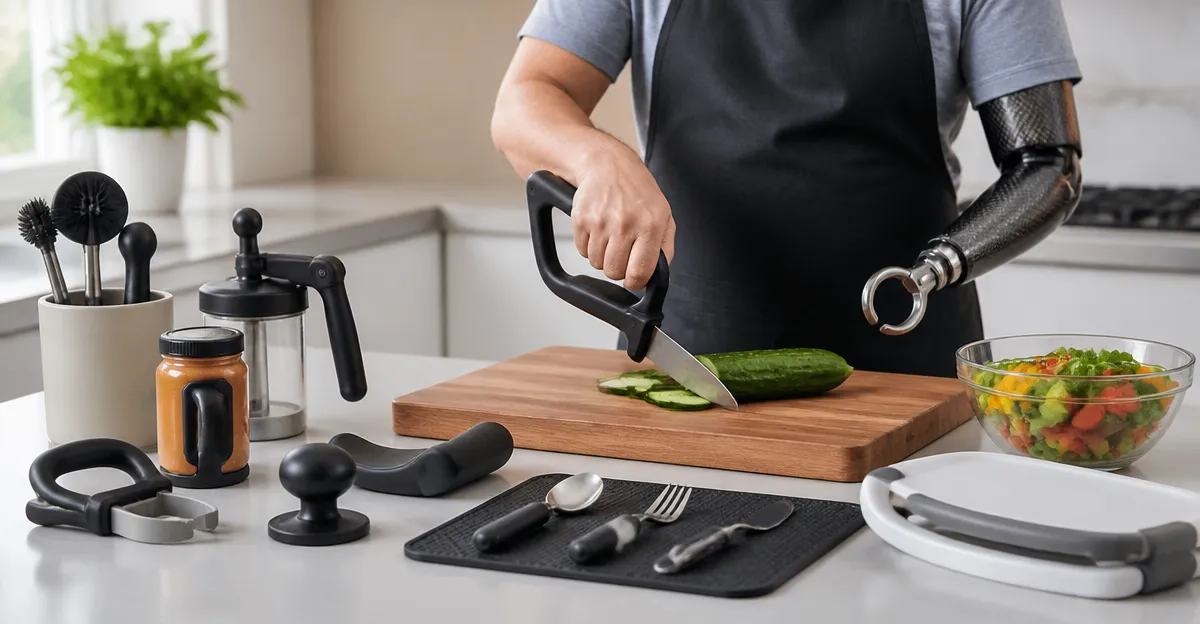
Adaptive Kitchen Starter Kit for Post-Amputation: The Complete Guide to Accessible Tools, One-Handed Techniques & Regaining Independence
Introduction
This guide explains how individuals who have undergone amputation can rebuild kitchen independence using adaptive equipment and proven one‑handed techniques. Readers will learn the essential categories of tools, how to evaluate product features, and practical strategies for safe food preparation. The content balances theoretical knowledge with real‑world product recommendations, ensuring value even for readers who choose not to purchase. By the end of the article, one will possess a clear roadmap for assembling a functional adaptive kitchen starter kit.
Background & Context
Post‑amputation kitchen challenges stem from the loss of bilateral grip, reduced wrist stability, and the need for safe, repeatable motions. Adaptive design principles focus on reducing the number of required hand motions, providing secure food placement, and transferring load from the hand to larger muscle groups. Understanding concepts such as leverage, non‑slip surfaces, and modular blade systems is crucial before selecting equipment. This foundation enables users to match tools to their specific range of motion, strength, and daily cooking routines.
Essential Adaptive Cutting Boards
Cutting boards that secure food and allow blade changes with a single hand are the cornerstone of an accessible kitchen. Two products exemplify these principles.
- CALYVE Adaptive Cutting Board features a movable press block that releases blade locks one at a time, enabling six interchangeable mandoline blades without flipping the board. Built‑in stainless steel spikes and a safety peeler hold food securely, while silicone non‑slip pads keep the board stable. The board is designed for stroke survivors, amputees, and anyone with limited hand function. Rating: 4/5 from nine reviews; price $39.99.
- SENDAR Adaptive Cutting Board offers a solid acacia hardwood surface with non‑slip silicone feet and ten food‑grade stainless steel spikes. A raised rear fence prevents spills, and beveled edges allow one‑handed sliding onto plates. Finger recesses provide a three‑sided grip for easy lifting. Rating: 4.4/5 from 114 reviews; price $44.99.
Both boards eliminate the need for a second hand to steady ingredients, but they differ in material durability and blade versatility. CALYVE includes a full mandoline system, while SENDAR focuses on spike stability and spill prevention.
One‑Handed Jar, Bottle, and Plate Stabilization Aids
Opening jars, bottles, and keeping plates from sliding are common obstacles for users with limited grip strength. Two solutions address these tasks.
- Otstar Jar & Bottle Opener provides a six‑in‑one mechanism with eight circular openings, a sharp hook for tight lids, and a straight hook for ring‑pull cans. The long handle offers leverage, while rubber lining ensures a non‑slip grip. Rating: 4.4/5 from 20,305 reviews; price $6.99.
- JINUPHION One‑Handed Aid Set includes five reusable anti‑slip mats that attach to the bottom of plates, bowls, or bottles. The transparent design preserves aesthetics, and the mats also function as grip enhancers for pet food bowls. Rating: 4.4/5 from 72 reviews; price $9.99.
Otstar excels at leverage for stubborn lids, while JINUPHION offers a versatile, low‑cost solution for stabilizing a variety of dinnerware items.
Pan Handling and Leverage Devices
Heavy cookware such as cast‑iron skillets can strain the wrist when lifted with a single hand. A vertical handle attachment redistributes weight to the forearm and reduces heat transfer.
- Pan Buddy Handle Attachment creates a vertical lever that keeps the wrist in a natural position, decreasing joint strain. The universal design fits handles up to two inches in diameter, and the separate handle isolates heat, eliminating the need for oven mitts. Rating: 4/5 from 371 reviews; price $14.98.
This accessory is particularly valuable for users who must maneuver large pans while maintaining a safe distance from heat sources.
Comparison & Selection Guide
| Category | Product | Key Strength | Ideal User | Price |
|---|---|---|---|---|
| Cutting Board | CALYVE Adaptive Cutting Board | Interchangeable mandoline blades, built‑in peeler | Users needing slicing versatility | $39.99 |
| Cutting Board | SENDAR Adaptive Cutting Board | Robust wood, spike stability, spill fence | Users prioritizing durability | $44.99 |
| Jar/Bottle Opener | Otstar Jar & Bottle Opener | Six‑in‑one functionality, strong leverage | Users with weak grip | $6.99 |
| Anti‑Slip Mats | JINUPHION One‑Handed Aid Set | Reusable, transparent, multi‑use | Budget‑conscious users | $9.99 |
| Pan Handle | Pan Buddy Handle Attachment | Vertical leverage, heat isolation | Users handling heavy cookware | $14.98 |
When choosing, consider the primary cooking tasks, the level of wrist strain, and budget constraints. For a balanced kit, combine one cutting board, one jar opener, and the Pan Buddy. Add the JINUPHION mats if plate stability is a frequent concern.
Best Practices & Tips
- Secure the workspace: Place silicone pads or JINUPHION mats under all work surfaces to prevent movement.
- Practice blade changes on a dry board before handling food; the CALYVE movable press block is designed for one‑handed operation.
- Use the Pan Buddy’s vertical handle to lift heavy pans, keeping the wrist neutral and reducing torque on the forearm.
- When opening jars, position the Otstar opener so the handle aligns with the forearm for maximal leverage; avoid twisting motions.
- Clean spikes and blades immediately after use to prevent food buildup; a soft toothbrush works well for stainless steel spikes.
- Store all adaptive tools within easy reach, preferably on a dedicated shelf, to minimize unnecessary reaching.
Frequently Asked Questions
- Can I use the CALYVE cutting board with a regular chef’s knife? Yes, the board’s surface is compatible with standard knives; the built‑in spikes will hold food while the knife performs the cut.
- Is the Otstar opener suitable for large mason jars? The hook mechanism can break the vacuum seal on jars up to three inches in diameter, making it effective for most mason jars.
- How do I attach the Pan Buddy to a pan with a non‑circular handle? The wrist support includes an adjustable opening that accommodates handles up to two inches; for irregular shapes, align the widest part with the opening.
- Do the JINUPHION mats affect the taste of food? The mats are made of food‑grade, transparent silicone that does not impart flavor; they are also odor‑free.
- What maintenance is required for the SENDAR cutting board? Wipe the board with a damp cloth after each use; the stainless steel spikes can be cleaned with a toothbrush and mild soap.
- Can these tools be used by left‑handed individuals? All products are ambidextrous; the cutting boards and Pan Buddy can be oriented for either hand.
- Is there a warranty on these adaptive tools? CALYVE offers a six‑month warranty; other products typically have standard manufacturer warranties ranging from 30 days to one year.
Conclusion
Regaining kitchen independence after amputation is achievable through thoughtful selection of adaptive tools and disciplined technique. By integrating a versatile cutting board, reliable jar opener, anti‑slip stabilization, and a leverage‑enhancing pan handle, users can perform most cooking tasks with a single hand safely. Continuous practice, proper maintenance, and ergonomic positioning further reinforce long‑term independence. The recommended starter kit balances cost, functionality, and durability, providing a solid foundation for an accessible kitchen.
Products Featured in This Guide
CALYVE Adaptive Cutting Board
Price: $39.99 | Rating: 4/5 (9 reviews)
Featured for its one‑handed blade‑swap system, built‑in peeler, and adaptable press block that enable precise slicing without assistance.
JINUPHION One-Handed Aid Set
Price: $9.99 | Rating: 4.4/5 (72 reviews)
Featured for its reusable anti‑slip mats that secure plates, bowls, and bottles, providing stability for one‑handed eating and cooking.
Pan Buddy Handle Attachment
Price: $14.98 | Rating: 4/5 (371 reviews)
Featured for its vertical leverage design that reduces wrist strain and isolates heat, making heavy pans manageable with one hand.
Otstar Jar & Bottle Opener
Price: $6.99 | Rating: 4.4/5 (20,305 reviews)
Featured for its multi‑size opening system and ergonomic handle, providing effortless leverage for stubborn lids.
SENDAR Adaptive Cutting Board
Price: $44.99 | Rating: 4.4/5 (114 reviews)
Featured for its sturdy acacia wood, ten stainless spikes, and spill‑preventing rear fence, offering a reliable platform for one‑handed prep.