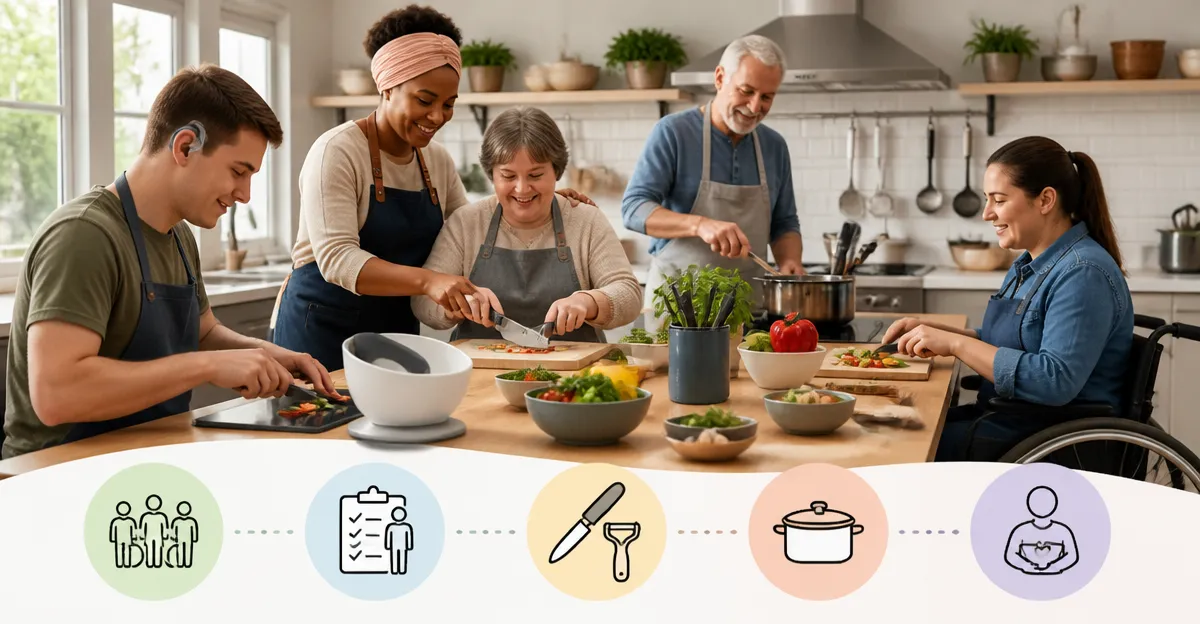
Introduction
Running a cooking class that welcomes participants of varying abilities requires careful planning, inclusive curriculum design, and thoughtful use of tools. This guide will teach readers how to design, prepare, and deliver a class that is both educational and accessible, while highlighting products that can serve as reliable resources. By following the step‑by‑step instructions, instructors will learn how to create a safe environment, adapt techniques, and foster confidence among all learners. The result is a class that empowers every participant to enjoy the creative process of cooking.
What You’ll Need
- Accessible kitchen workspace with adjustable countertops and clear pathways.
- Adaptive cooking tools such as easy‑grip knives, tactile measuring cups, and stable cutting boards.
- Curriculum resources that explain techniques in plain language and include visual aids.
- Reference books that provide foundational skills, flavor inspiration, and scientific insight.
- Safety equipment including non‑slip mats and fire‑extinguishing devices.
Step 1: Define Learning Objectives and Accessibility Goals
Begin by outlining clear, measurable objectives for the class, such as mastering basic knife skills, understanding flavor pairings, or applying food‑science principles. Write these objectives in language that is easy to understand for participants with diverse cognitive abilities. Next, establish accessibility goals that address mobility, vision, hearing, and neurodiversity, for example, providing captioned video demonstrations or tactile recipe cards. Document the goals in a brief plan that will guide all subsequent decisions.
Step 2: Choose an Inclusive Curriculum and Core Reference
Select a curriculum that balances step‑by‑step instruction with opportunities for creative exploration. A highly regarded resource for foundational cooking techniques is America’s Test Kitchen Cooking School. This hardcover cookbook offers 80 focused courses, over 400 recipes, and more than 200 kitchen hacks, making it ideal for beginners and experienced cooks alike. Its clear sections, infographics, and scientific explanations help learners grasp concepts quickly, which is essential when teaching mixed‑ability groups. The book is priced at $29.07 and holds a 4.8‑star rating from 1,520 reviews, indicating strong user satisfaction.
Integrate the book’s structured modules into your lesson plan, assigning one course per session. Use the infographic pages as visual supports for participants who benefit from pictorial cues. Because the content is organized from basic to advanced, you can easily adjust the difficulty level based on the group’s progress.
Step 3: Prepare the Kitchen Space for Accessibility
Arrange the cooking area so that all stations are reachable from a seated or standing position, depending on participant needs. Install adjustable-height worktables or provide portable risers to accommodate wheelchair users. Ensure clear floor space of at least 36 inches around each station to allow smooth movement. Place non‑slip mats on wet surfaces and label equipment with tactile stickers for visually impaired learners.
Safety is paramount; position fire extinguishers within arm’s reach and demonstrate their use early in the class. Use colour‑coded handles on burners to help participants differentiate between hot and cold zones. These environmental modifications reduce barriers and allow every learner to focus on the culinary tasks.
Step 4: Select Adaptive Tools and Reference Materials
Equip each station with adaptive tools that simplify common tasks. For example, ergonomic knives with wide, cushioned handles reduce strain for participants with limited hand strength. When measuring ingredients, provide both standard measuring cups and tactile, colour‑coded versions to aid those with visual impairments.
To inspire creativity and deepen flavor knowledge, incorporate The Flavor Bible. This hardcover reference contains thousands of ingredient pairings, organized alphabetically, and is praised for its exhaustive cross‑references. Priced at $36.32 with a 4.7‑star rating from 9,591 reviews, it serves as a quick lookup guide during hands‑on activities, enabling participants to experiment confidently.
For younger participants or those who enjoy a playful approach, consider ATK Complete Cookbook for Young Chefs. Although designed for children, its clear step‑by‑step photos and simple language make it a valuable visual aid for adult beginners as well. At $11.35 and a 4.8‑star rating from 25,776 reviews, it offers over 100 recipes that reinforce basic techniques while keeping the atmosphere light.
Step 5: Conduct the Class with Clear Demonstrations
Begin each session with a brief overview of the day’s objectives, referencing the chosen curriculum module. Use a large screen or projector to display the recipe page from America’s Test Kitchen Cooking School, ensuring that text is large enough for participants with low vision. Narrate each step slowly, pausing to check comprehension.
Demonstrate techniques using the adaptive tools, explaining why each tool is beneficial. For instance, when chopping vegetables, highlight how the ergonomic knife reduces fatigue and improves control. Encourage participants to follow along, offering one‑on‑one assistance as needed.
Integrate flavor exploration by consulting The Flavor Bible during the seasoning phase. Ask learners to suggest complementary herbs for a given protein, reinforcing the concept of taste harmony. This interactive element promotes critical thinking and makes the class more engaging.
Step 6: Provide Follow‑Up Resources and Feedback
After the cooking activity, distribute printed recipe cards that include tactile symbols for key steps, such as a raised dot for “stir” and a textured line for “bake”. Offer digital copies with captioned video walkthroughs for participants who prefer to review at home. Encourage learners to record their own cooking attempts and share them with the group, fostering a supportive community.
Collect feedback through a short, accessible survey that asks about clarity of instructions, comfort with tools, and overall enjoyment. Use the responses to refine future classes, adjusting the curriculum pace or tool selection as needed. Providing constructive feedback to participants also reinforces their progress and builds confidence.
Tips & Pro Tips
- Use colour‑coded cutting boards to differentiate between raw proteins and vegetables, reducing cross‑contamination risks.
- Offer a “quiet corner” with headphones for participants who are sensitive to auditory overload.
- When explaining scientific concepts, refer to The Science of Cooking for clear, question‑and‑answer style explanations. This book, priced at $25.85 with a 4.8‑star rating from 4,524 reviews, breaks down complex processes into digestible facts.
- Incorporate a short “science experiment” from Highlights Science Cookbook for Kids to illustrate concepts such as emulsification or caramelization. The hands‑on experiment reinforces learning for visual and kinesthetic learners.
- Maintain a calm, predictable routine: welcome, safety briefing, demonstration, hands‑on practice, clean‑up, and debrief. Predictability helps participants with neurodivergent profiles feel secure.
Troubleshooting
Problem: A participant struggles with knife control.
Solution: Provide a serrated safety knife with a wide, non‑slip handle and demonstrate a rocking motion using a guide board. Allow extra practice time and offer verbal cues.
Problem: The aroma of a dish overwhelms a sensory‑sensitive learner.
Solution: Increase ventilation by opening windows or using an exhaust fan, and offer the learner a seat farther from the cooking station.
Conclusion
Creating an accessible cooking class for mixed‑ability groups is achievable by defining clear objectives, selecting inclusive curriculum resources, adapting the kitchen environment, and employing supportive tools. By integrating reputable references such as America’s Test Kitchen Cooking School, The Flavor Bible, and The Science of Cooking, instructors can deliver a rich, engaging experience that builds confidence and culinary competence. Encourage participants to continue experimenting at home, and use feedback to evolve the class for future sessions.
Products Mentioned in This Guide
Frequently Asked Questions
What are the essential adaptations for an accessible kitchen workspace?
Use adjustable countertops, clear pathways, and non‑slip mats to accommodate wheelchairs, standing learners, and mobility aids.
Which adaptive cooking tools improve safety for mixed‑ability participants?
Easy‑grip knives, tactile measuring cups, and stable cutting boards help users with limited hand strength or vision.
How should learning objectives be written for an inclusive cooking class?
State clear, measurable goals in plain language, focusing on skill mastery, safety, and confidence for all ability levels.
What curriculum resources support diverse learners?
Include visual step‑by‑step guides, plain‑language instructions, and reference books that cover basic techniques and flavor science.
How can instructors ensure safety during a mixed‑ability cooking session?
Provide fire‑extinguishers, demonstrate proper tool handling, and keep a clutter‑free workspace with clear emergency procedures.