Introduction
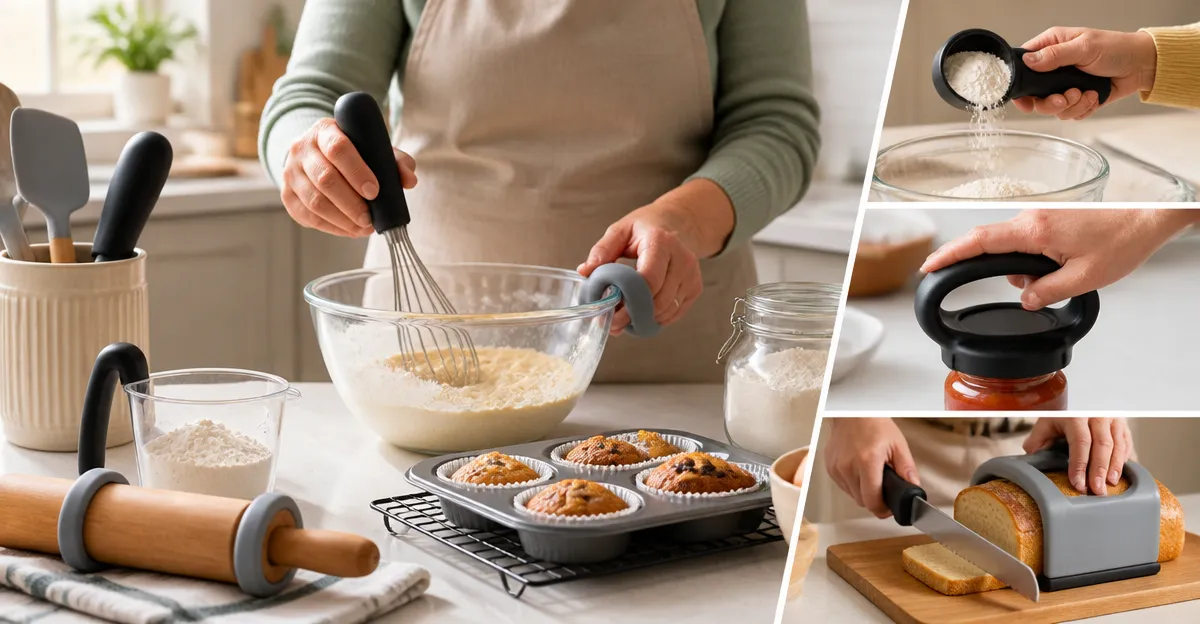
This guide explains how individuals who experience tremors can bake with confidence, safety, and enjoyment. It outlines practical recipe adjustments, demonstrates the use of adaptive kitchen tools, and provides expert tips to reduce strain and increase precision. Readers will learn how to organise the workspace, select appropriate utensils, and modify techniques to accommodate limited motor control. The information is valuable because it empowers people with hand‑movement challenges to maintain independence in the kitchen while producing reliable results.
What You’ll Need
- Bench Scraper – $7.33, rating 4.8/5
- Silicone Pastry Mat – $9.99, rating 4.8/5
- Silicone Spatula Set – $6.99, rating 4.8/5
- Rocker Knife – $19.99, rating 4.6/5
- One‑Handed Kitchen Aid Set – $9.99, rating 4.4/5
Step 1: Prepare a Stable Workspace
A stable surface reduces unintended movement and provides a reliable foundation for all subsequent actions. Begin by clearing the countertop of unnecessary items and wiping it clean. Place the Silicone Pastry Mat in the centre of the work area. The mat measures 28×20 inches, offering ample space for rolling dough, measuring portions, and containing spills. Its non‑slip silicone backing prevents the mat from shifting when a tremor occurs, and the built‑in measurement markings eliminate the need for separate rulers, thereby simplifying precision tasks.
Secure any bowls or mixing containers to the mat using the One‑Handed Kitchen Aid Set. The adhesive mats included in this set attach firmly to both the countertop and the base of a bowl, allowing the user to hold a single hand free for stirring or pouring. This dual‑grip system also protects against accidental spills, a common concern for individuals with limited hand stability.
Step 2: Measure Ingredients Accurately
Accurate measurement is essential for baking success, yet tremors can make pouring or scooping inconsistent. Utilize the measurement marks on the Bench Scraper to portion dry ingredients. The scraper features 1/4‑inch marks along its 6‑inch stainless‑steel blade, enabling the baker to slide the tool across the mat and create uniform piles of flour, sugar, or chopped nuts. Because the blade is square‑edged, it can also be used to lift and transfer measured portions without spilling.
For liquid ingredients, the One‑Handed Kitchen Aid Set includes a suction‑based grip that holds a measuring cup steady while the user tilts the container with a single hand. This method reduces the need for simultaneous two‑hand coordination, thereby decreasing the likelihood of over‑pouring.
Step 3: Mix and Combine Ingredients
When mixing, the goal is to minimise repetitive motions that can exacerbate tremor fatigue. The Silicone Spatula Set offers five sizes, each designed for specific tasks. The large spoon spatula is ideal for folding batter in a deep bowl, while the medium spatula with a flat edge excels at scraping the sides of the Silicone Pastry Mat to retrieve any stuck dough. Because the spatulas are constructed from food‑grade silicone with a stainless‑steel core, they resist warping under heat and provide a firm grip that does not slip from the hand.
To further reduce strain, employ the One‑Handed Kitchen Aid Set to stabilise the mixing bowl. The adhesive mat adheres to the bowl’s rim, allowing the user to press the spatula against the side of the bowl without the bowl moving. This technique provides a controlled environment for stirring, whisking, or folding, and the silicone material of the spatulas ensures easy release of batter without tearing.
Step 4: Portion and Shape Dough
Portioning dough evenly is critical for consistent baking times. Place the dough on the Silicone Pastry Mat and use the Bench Scraper to cut strips or squares along the measurement lines. The contoured, non‑slip handle of the scraper provides a secure grip, reducing the chance of the tool slipping due to tremor‑induced hand motion. The stainless‑steel blade is rust‑resistant, ensuring long‑term durability even with frequent washing.
If the recipe calls for shaping rounded cookies or pie crusts, the circular markings on the mat serve as visual guides. The user can roll the dough to the desired thickness and then use the scraper’s square edge to cut circles directly on the mat, eliminating the need for separate cookie cutters that may be difficult to manoeuvre.
Step 5: Cut and Transfer Finished Baked Goods
After baking, the challenge often lies in cutting and serving without excessive force. The Rocker Knife is specifically engineered for one‑handed operation. Its vertical grip and curved blade enable the user to rock the knife forward, generating a slicing motion that requires minimal wrist stability. The blade’s stainless‑steel construction maintains sharpness, allowing clean cuts through cakes, bread, or fruit without crushing delicate textures.
For items that require lifting, such as a slice of cake, the One‑Handed Kitchen Aid Set can be employed again. By affixing the adhesive mat to the plate, the baker can slide the slice onto the plate while the mat prevents the plate from sliding, ensuring a smooth transfer with a single hand.
Tips & Pro Tips
- Arrange all tools within arm’s reach before beginning; this reduces the need for unnecessary movement.
- Use a timer with a loud alarm to avoid the temptation to check the oven repeatedly, which can increase tremor activity.
- When possible, pre‑measure dry ingredients into individual containers; this limits the number of scooping actions required.
- Keep a damp cloth nearby to wipe the bench scraper and spatulas between uses; a clean surface prevents dough from sticking and reduces the effort needed to release ingredients.
- Consider using silicone gloves for additional grip if the hands become sweaty during extended baking sessions.
Troubleshooting
| Problem | Possible Cause | Solution |
|---|---|---|
| Ingredients spill off the mat | Mat not fully adhered to countertop | Re‑apply the One‑Handed Kitchen Aid Set adhesive mat to both the countertop and the mat base for extra grip. |
| Scraper slips while cutting | Hand fatigue or insufficient grip | Hold the scraper closer to the handle’s contoured section and rest the opposite hand on the mat for additional stability. |
| Rocker knife feels unstable | Improper hand positioning | Place the thumb on the vertical grip and allow the natural rocking motion to guide the blade; practice on a soft vegetable before using on baked goods. |
Conclusion
The techniques presented in this guide enable individuals with tremors to bake with confidence, precision, and safety. By preparing a stable workspace, employing measurement‑enhancing tools, and selecting adaptive utensils such as the Bench Scraper, Silicone Pastry Mat, Silicone Spatula Set, Rocker Knife, and One‑Handed Kitchen Aid Set, the baker can minimise the impact of involuntary movements. Consistent practice of the outlined steps will foster independence and allow the enjoyment of homemade baked goods without reliance on external assistance.
Products Mentioned in This Guide
Frequently Asked Questions
What adaptive kitchen tools help people with tremors bake more safely?
Tools like a bench scraper, silicone pastry mat, silicone spatula set, and a rocker knife provide stable grip and reduce the need for precise hand movements.
How can I modify recipes to accommodate limited motor control?
Use larger mixing bowls, pre‑measure ingredients, and opt for one‑bowl or no‑knead methods to minimize handling and stirring.
What workspace setup reduces strain while baking with tremors?
Arrange all frequently used items within arm’s reach, use a non‑slip mat, and keep the counter clear to prevent accidental spills.
Are there specific techniques for mixing dough when I have tremors?
Employ a stand mixer on low speed or use a hand‑held electric whisk, and let the tool do most of the work instead of manual stirring.
How do I ensure safety when handling hot pans and ovens?
Use heat‑resistant silicone gloves, a sturdy pot holder, and a stable, non‑slip surface to keep pans from sliding.