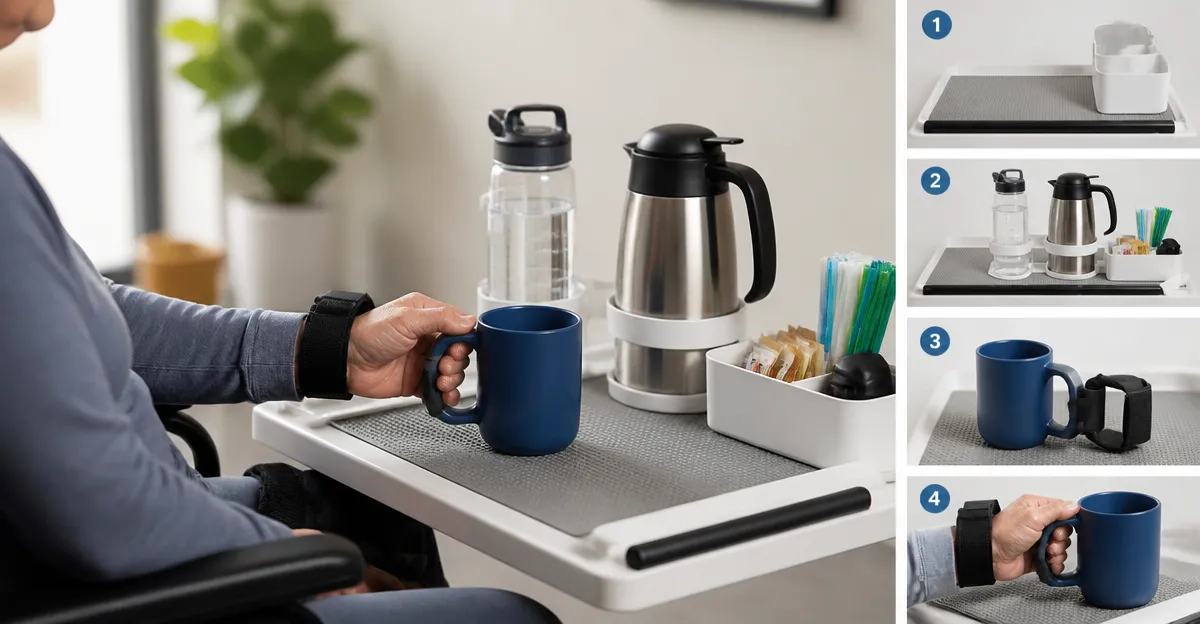
How to Set Up a One-Handed Beverage Station: Step-by-Step Accessible Guide
This guide explains how to create a beverage station that can be operated with a single hand, allowing individuals with limited mobility to enjoy drinks independently. Readers will learn how to select appropriate surfaces, arrange adaptive tools, and implement safety features that minimise spills. The instructions are designed for caregivers, occupational therapists, and adults who desire greater autonomy in daily routines. By following each step, one can transform a regular countertop into a functional, accessible hub.
What You’ll Need
- Sturdy table or rolling cart with non‑slip feet
- Adaptive utensils and dinnerware with suction base (Adaptive Utensils Bowl and Plate Set)
- Weighted adaptive cutlery for stirring (Nourislif Adaptive Utensils)
- 42° angled weighted utensils for precise control (BaseSmall Adaptive Utensils Set)
- Small drawer organizer or zip‑lock containers
- Spill‑resistant cup lids and silicone mat
- LED lighting strip for visibility
Step 1: Select a Stable Base
Begin by choosing a table or rolling cart that remains immobile during use. A surface with rubberised feet prevents unintended movement when the user reaches for a bottle. Position the cart near a power outlet if an LED lighting strip will be installed later. Stability at this stage reduces the risk of accidental spills and creates a reliable foundation for subsequent accessories.
Step 2: Attach the Suction‑Base Dinnerware
Place the bowl and plate from the Adaptive Utensils Bowl and Plate Set onto the chosen surface. The suction cups on the bottom of each piece lock the items firmly in place, preventing sliding when the user lifts a cup with one hand. This feature is especially valuable for individuals with tremors because it provides a predictable, non‑moving platform. The wide rim and deep sides of the bowl also help contain liquids, further reducing spill potential.
Step 3: Position Beverage Containers Within Easy Reach
Arrange water bottles, juice cartons, and coffee mugs on the plate or inside the bowl, depending on size. Keep the most frequently used container at the front edge so that a single hand can grasp the handle without overreaching. Use the plate’s raised lip as a natural barrier that keeps containers from sliding off the surface. This layout mimics a traditional coffee station while remaining fully accessible.
Step 4: Install a One‑Handed Cup Holder
If a dedicated cup holder is desired, a simple clamp can be affixed to the side of the table. Alternatively, the adaptive bowl itself can serve as a cup cradle by placing the mug upside‑down on the suction‑secured surface. The bowl’s anti‑skid rubber base ensures that the cup remains stable while the user lifts the lid with the same hand. This dual‑purpose approach reduces the number of separate accessories required.
Step 5: Provide a Weighted Stirring Tool
For beverages that require stirring, the Nourislif Adaptive Utensils set offers a weighted spoon with an ergonomic grip. Each piece weighs 2.7 oz, delivering enough mass to counteract hand tremors without causing fatigue. The stainless‑steel construction is rust‑proof and dishwasher‑safe, ensuring long‑term hygiene. By using this spoon, the user can mix coffee or tea with a single, controlled motion.
Step 6: Add a Spill‑Resistant Lid
Place a silicone‑lined lid on top of the beverage container to minimise accidental splashes. The lid should fit snugly over the mug’s opening while leaving a small opening for the straw or spoon. Because the adaptive plate’s high‑to‑low design creates a slight incline, any overflow will travel back toward the plate rather than onto the countertop. This simple addition enhances safety during rapid movements.
Step 7: Utilize the Adaptive Bowl for Microwave Heating
The bowl from the adaptive set is microwave‑safe, allowing users to heat beverages without transferring them to another container. Fill the bowl with water or milk, then place the cup inside the bowl to create a makeshift double‑boiler. The suction base keeps the bowl stationary, preventing it from shifting during heating. After warming, the user can remove the cup with one hand, guided by the bowl’s sturdy edges.
Step 8: Employ Angled Weighted Utensils for Precision
When fine control is required, such as adding a sugar packet, the BaseSmall Adaptive Utensils Set provides a 42° angled fork and spoon. The angled design reduces wrist rotation, which is beneficial for users with Parkinson’s disease or severe arthritis. Each utensil is weighted at 2.5 oz, offering stability without excessive heaviness. The non‑slip silicone grips further improve handling, making it easier to pick up small items.
Step 9: Organise Accessories with a Drawer Organizer
Place a small drawer organizer beneath the table to store tea bags, sugar packets, and napkins. Clear compartments allow the user to see contents at a glance, reducing the need for searching. Label each section with large, high‑contrast text for quick identification. This organisational step streamlines the preparation process and maintains a tidy workspace.
Step 10: Test the Workflow with One Hand
Conduct a trial run by performing the entire beverage preparation sequence using only the dominant hand. Observe any points where the user hesitates or experiences difficulty. Adjust the placement of containers, utensils, or lighting based on these observations. Repeating the test ensures that the station is truly one‑handed and user‑friendly.
Step 11: Enhance Visibility with LED Lighting
Install a low‑profile LED strip along the front edge of the table to illuminate the work area. Bright, even lighting assists users with reduced visual acuity in locating items quickly. Choose a colour temperature of 4000 K for a neutral white light that does not distort colour perception. The lighting should be positioned so that it does not create glare on reflective surfaces.
Step 12: Establish a Cleaning Routine
Develop a daily cleaning schedule that includes wiping the suction bases, washing the adaptive bowl, and sanitising the utensils. Because the bowl and plate are dishwasher‑safe, they can be placed in the top rack for convenience, while the suction cups should be hand‑washed to preserve adhesion. Regular maintenance extends the lifespan of the adaptive tools and maintains hygiene. Encourage the user to participate in the cleaning process as part of the independence routine.
Tips & Pro Tips
- Use colour‑coded handles on utensils to differentiate between stirring, sipping, and serving tools.
- Apply a non‑slip silicone mat underneath the entire station for added stability on polished floors.
- Consider a voice‑activated smart plug for the LED lighting to allow hands‑free operation.
- Store spare suction‑base plates in a dry container to prevent moisture loss.
Troubleshooting
- Problem: Suction base loses grip after repeated cleaning. Solution: Clean the suction surface with mild soap and water, then dry thoroughly before each use.
- Problem: Weighted utensils feel too heavy. Solution: Alternate with the lighter Nourislif spoon for tasks that require less force.
- Problem: Beverage spills despite lid. Solution: Verify that the lid is seated correctly and that the plate’s lip is not obstructed.
Conclusion
The one‑handed beverage station described in this guide empowers individuals with limited hand function to prepare drinks safely and independently. By selecting a stable base, integrating adaptive dinnerware, and employing weighted utensils, the station reduces the risk of spills and enhances confidence. Readers are encouraged to customise the layout to suit personal preferences and to revisit the setup periodically for improvements. An accessible beverage station not only promotes independence but also contributes to overall quality of life.
Products Mentioned in This Guide
Frequently Asked Questions
What type of surface should I use for a one‑handed beverage station?
Choose a sturdy table or rolling cart with non‑slip feet to keep the station stable during use.
Which adaptive utensils are recommended to reduce spills?
Use suction‑base bowls and plates, weighted stirring utensils, and 42° angled weighted tools for better control.
How can I ensure the beverage station stays safe and spill‑free?
Secure all items with non‑slip pads, keep liquids within easy reach, and arrange tools so they’re accessible with one hand.
Who can benefit most from a one‑handed beverage station?
Individuals with limited mobility, caregivers, occupational therapists, and anyone seeking greater independence in daily drink preparation.
What maintenance is needed for the adaptive tools?
Regularly clean the suction bases and check weighted parts for wear to maintain grip and functionality.